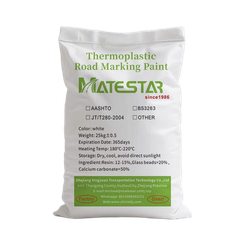

Quick Answer
Thermoplastic road marking paint settles because it contains heavy solid particles such as quartz sand, mineral fillers and glass beads. When the paint melts, these particles tend to move downward under gravity. Settling becomes faster when the particles are large, the molten paint viscosity is too low, the temperature is too high, or stirring stops.
The goal is not to eliminate settling completely. A good formulation should control settling while maintaining proper flow, leveling, wear resistance and glass bead performance.
What Is Settling in Thermoplastic Road Marking Paint?
Thermoplastic road marking paint is not a simple liquid.
After melting, it contains a molten binder system together with solid materials such as:
- quartz sand;
- calcium carbonate and other mineral fillers;
- pigments;
- intermixed glass beads.
These solid particles are heavier than the molten organic phase. If the molten paint cannot keep them suspended, they gradually move toward the bottom of the thermoplastic preheater.
This is what contractors call settling.
A small amount of settling is not unusual. The real problem is rapid or severe settling that causes the material to become uneven during construction.

Why Does Thermoplastic Paint Settle?
1. Particle Size and Density
Larger and heavier particles settle faster.
In thermoplastic paint, quartz sand and glass beads are especially important because their density is much higher than that of the molten resin system.
Particle size also matters.
Larger particles normally settle more easily than fine particles. However, simply reducing the quartz sand size is not a good solution.
Your source material points out that reducing quartz sand too much, or replacing too much sand with fine mineral powder, may improve flow and reduce settling but can also reduce wear resistance and increase the risk of cracking.
So particle size must be balanced with the mechanical performance of the finished marking.
2. Molten Paint Viscosity
Viscosity provides resistance against particle movement.
The relationship is simple:
Lower viscosity → faster settling
Higher viscosity → slower settling
But higher viscosity is not always better.
If the molten paint is too viscous:
- flow leveling becomes poor;
- screed application becomes difficult;
- the surface may become rough;
- glass bead embedment may be insufficient.
If the viscosity is too low:
- solid particles settle faster;
- the line may flow at the edges;
- glass beads may sink too deeply.
The correct target is therefore stable suspension with suitable application viscosity, not maximum viscosity.
3. Melting Temperature
Temperature directly changes melt viscosity.
As the temperature rises, thermoplastic paint normally becomes less viscous. This improves flow, but it also reduces the resistance that keeps heavy particles suspended.
Therefore:
Higher temperature can increase settling if the paint is held in the molten state for too long.
The material should be heated to the supplier's recommended working temperature, fully melted and mixed, then used without unnecessary long-term high-temperature holding.For the complete melting and construction procedure, see [How to Apply Thermoplastic Road Marking Paint]
Excessive temperature also creates other risks, including resin aging and yellowing of white thermoplastic road markings.
4. Insufficient Stirring
Continuous stirring keeps the solid materials distributed throughout the molten paint.
If stirring stops, heavier particles gradually collect at the bottom.
This is especially important for thermoplastic materials containing intermixed glass beads.
Your technical notes also warn that if leftover molten material is kept hot without stirring, glass beads and other heavy particles can accumulate at the bottom of the kettle. Reheating this settled material can then lead to bottom scorching or difficult discharge.
For stable application:
- keep the material properly stirred during melting;
- continue stirring during long holding periods;
- do not allow a full kettle of molten material to remain stationary for a long time.
What Problems Can Severe Settling Cause?
Severe settling changes the composition of the material from the top of the kettle to the bottom.
This can cause:
| Problem | Possible Result |
|---|---|
| Uneven material composition | Different performance from the first line to the last |
| Filler accumulation at the bottom | Difficult discharge |
| Glass bead accumulation | Uneven intermixed bead content |
| Poor mixing | Unstable flow and line appearance |
| Bottom deposits | Local overheating and scorching |
| Excessive fine filler used to prevent settling | Lower wear resistance or poorer crack resistance |
The most important issue is therefore not whether the paint settles at all, but whether the material can remain sufficiently uniform during normal construction.
Is Zero Settling Always Better?
No.
This is an important point.
Thermoplastic paint must balance several properties at the same time:
- suspension stability;
- flow;
- leveling;
- wear resistance;
- crack resistance;
- glass bead embedment;
- application speed.
A formulation designed only to prevent settling may become too viscous or may use too much fine filler.
That can create other problems.
For example, your technical material specifically notes that using overly fine quartz sand or increasing mineral powder simply to reduce settling can weaken wear resistance and affect cracking performance.
So the correct question is not:
"Does this thermoplastic paint settle?"
It is:
"Does the settling remain controllable under normal melting and stirring conditions without affecting application performance?"
How to Reduce Settling
1. Balance Particle Size Distribution
Do not simply replace coarse particles with fine powder.
Quartz sand, mineral filler and glass beads should be balanced so the material has both acceptable suspension stability and sufficient mechanical strength.
2. Maintain Suitable Melt Viscosity
The molten material should be viscous enough to slow particle settling but still fluid enough for stable application.
The correct viscosity depends on:
- formulation;
- application method;
- working temperature;
- pavement condition.
3. Control Melting Temperature
Avoid unnecessary overheating.
Use the recommended working temperature and do not keep the material at high temperature longer than necessary.
4. Keep the Material Stirring
Proper agitation is one of the simplest ways to control settling during construction.
Before discharge, make sure the material is fully melted and evenly mixed.
If the material has been standing for some time, restore uniform mixing before application.
5. Do Not Solve Settling by Sacrificing Other Properties
Reducing settling by using excessive fine filler or making the material extremely viscous may create:
- poor leveling;
- poor glass bead embedment;
- reduced wear resistance;
- higher crack risk.
A stable thermoplastic formulation must balance all these properties.
How to Judge Whether Settling Is Acceptable
A practical evaluation should check three things:
Settling speed
Does severe separation occur within normal melting and construction time?
Redispersibility
Can normal stirring restore the material to a uniform state?
Application consistency
Does line thickness, flow, bead distribution and surface finish remain stable from the beginning to the end of the kettle?
If normal agitation keeps the material uniform and the finished marking remains consistent, a small amount of settling is usually manageable.
If heavy deposits form quickly and cannot be redistributed, the formulation or melting process should be reviewed.
Final Takeaway
Thermoplastic road marking paint settles because heavy solid particles move downward in the molten material.
The main factors are:
- particle size and density;
- melt viscosity;
- temperature;
- stirring;
- overall formulation balance.
The best thermoplastic paint is not the one that never settles.
It is the one that keeps settling under control while still providing good flow, leveling, wear resistance, crack resistance and glass bead performance.These properties should be evaluated together when selecting thermoplastic road marking paint for a specific project and application condition