Quick Answer
To import thermoplastic road marking paint from China, buyers should first confirm the project standard, application method, marking thickness, climate and required quantity. Before ordering, compare the technical specification and actual coverage-not only the price per ton.
Also confirm the sample, packaging, container capacity, shipping terms and whether matching glass beads and road marking machines are required. Purchasing compatible paint, glass beads and equipment from one supplier can reduce application problems after delivery.
Why Import Thermoplastic Road Marking Paint from China?
China has an established supply chain for thermoplastic road marking materials, including:
- Thermoplastic road marking paint
- Reflective glass beads
- Thermoplastic preheaters
- Hand-push road marking machines
- Road marking accessories
For importers, distributors and road marking contractors, purchasing from China offers access to different formulations, customized packaging and complete road marking systems.
However, thermoplastic paint is not a universal product. The correct formula depends on the road, climate, application method and project specification.
1. Confirm the Project Requirements First
Before requesting a quotation, provide the supplier with the following information:
| Information required | Why it matters |
|---|---|
| Destination country and port | Determines the shipping route and quotation terms |
| Project standard or specification | Determines the required formula and test values |
| Asphalt or concrete surface | Affects adhesion and primer requirements |
| Road type and traffic level | Influences wear-resistance requirements |
| Local climate | Influences softening point and high-temperature performance |
| Screed, extrusion or spray application | Determines the required flowability |
| Required thickness | Affects material consumption and coverage |
| White, yellow or another color | Affects pigment selection and price |
| Required quantity | Determines production and container planning |
If the paint is intended for a government or tender project, send the complete technical specification instead of providing only the name of a standard.
Requirements under AASHTO M 249, BS 3262, EN 1871 and JT/T 280 are not identical. Even projects using the same standard may specify different performance levels.
2. Do Not Compare Paint Only by Price per Ton
Thermoplastic road marking paint contains resin, pigments, fillers, reflective glass beads and other additives. Changing the proportion or quality of these materials affects:
- Melting performance
- Flowability
- Whiteness and color stability
- Adhesion
- Glass bead retention
- Wear resistance
- Coverage
- Service life
A lower price per ton does not necessarily produce a lower project cost.
The more useful calculation is:
Paint cost per square meter = Price per ton ÷ Actual coverage per ton
For example, if one paint is cheaper but requires more material to form a 2 mm marking, the total material cost may be higher.
The quotation should therefore be evaluated together with the technical specification, required thickness and expected coverage.
3. Check the Actual Coverage
Coverage should always be stated together with the test conditions. A coverage figure without the application thickness and method has little practical value.
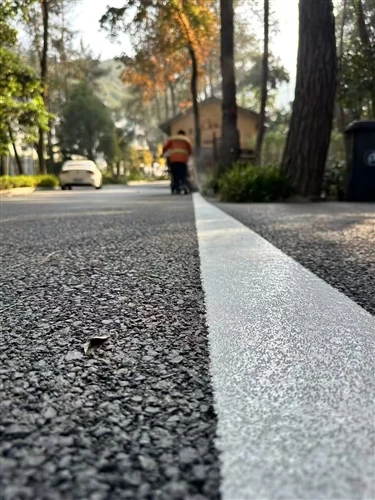
In an on-site screed application test, MATESTAR's standard JT/T 280 thermoplastic road marking paint covered approximately 228–230 m² per ton at a thickness of 2 mm.
| Test item | Test condition |
|---|---|
| Paint type | Standard JT/T 280 thermoplastic paint |
| Application method | Screed application |
| Marking thickness | 2 mm |
| Test type | On-site application test |
| Measured coverage | Approximately 228–230 m²/ton |
Actual coverage may vary depending on:
- Pavement condition
- Application thickness
- Equipment adjustment
- Material temperature
- Construction technique
- Material loss during heating and application
Buyers should compare coverage under similar conditions rather than comparing two unsupported figures.
4. Test the Paint Before a Bulk Order
When working with a new thermoplastic road marking paint supplier, testing a sample can reduce procurement risk.
The test should focus on actual application performance, including:
- Melting condition
- Flowability
- Heating stability
- Color and whiteness
- Drying time
- Surface finish
- Glass bead distribution
- Finished marking appearance
Whenever possible, use the same preheater and marking machine that will be used on the project.
The test conditions should also be recorded. A sample tested at a different temperature, thickness or application method may not accurately represent its performance during construction.
5. Confirm the Packaging and Container Loading
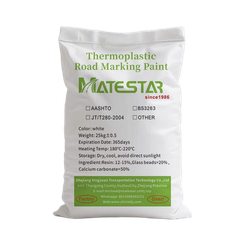
MATESTAR thermoplastic road marking paint is normally supplied in 25 kg bags.
| Packaging item | Details |
|---|---|
| Net weight | 25 kg per bag |
| Bags per ton | 40 bags |
| Maximum reference loading for 20GP | Approximately 27 tons |
| Bags in a 27-ton shipment | 1,080 bags |
| Loading method | Palletized or floor-loaded |
| Available bag types | Woven, laminated or EVA bags |
| OEM packaging MOQ | 5 tons |
| Shelf life | 12 months |
A 20GP container can load up to approximately 27 tons under suitable shipping conditions. The final loading quantity must still be confirmed according to the container payload, shipping line and destination regulations.
Floor loading generally allows more efficient use of container space. Pallets make unloading and warehouse handling easier, but they occupy additional space and add weight.
The paint should be kept unopened in a dry storage area and protected from moisture and damaged packaging.
6. Confirm OEM Packaging Before Production
Customized packaging is important for importers and distributors selling under their own brands.
MATESTAR can provide:
- Customized bag material
- Customer logo printing
- Product name and specification
- English or local-language labeling
- White, yellow and other product identification
- Woven, laminated or EVA bags
- The minimum quantity for OEM packaging is 5 tons.
Before production, buyers should confirm:
- Final bag artwork
- Printing colors
- Product description
- Net weight
- Standard or formula information
- Manufacturer and importer details
- Destination-market labeling requirements
The final artwork should be approved before printing.
7. Decide Whether You Also Need Glass Beads
Glass beads are used to provide night-time retroreflection. They may be premixed into the thermoplastic paint and applied to the surface during construction.
Before ordering, confirm:
- Premixed glass bead content
- Drop-on glass bead specification
- Particle size distribution
- Refractive index
- Roundness
- Surface application rate
- Project retroreflectivity requirement
The paint formula and glass beads should work as one system. Incompatible materials or incorrect application can lead to poor bead embedment and insufficient night-time visibility.
Importing the paint and matching glass beads together can simplify technical coordination.
8. Check Equipment Compatibility
Thermoplastic road marking paint must be heated and applied with suitable equipment.
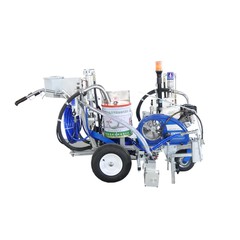
A basic thermoplastic road marking system normally includes:
- Thermoplastic preheater
- Hand-push or self-propelled marking machine
- Screed, extrusion or spray application system
- Gas or fuel system
- Supporting tools and accessories
Tell the supplier which application method you use before confirming the paint formula.
Screed, extrusion and spray applications require different material behavior. A paint that performs well in a screed machine may not have the correct flowability for thermoplastic spray equipment.
For buyers entering the thermoplastic marking market, purchasing the paint and equipment as a complete system can reduce compatibility problems.
9. A Complete Road Marking Supply Case in Syria
A customer in Syria required more than thermoplastic paint. The customer also needed the equipment required to melt and apply the material.
MATESTAR supplied:
- Thermoplastic road marking paint
- A thermoplastic preheater
- A hand-push thermoplastic road marking machine
This created a complete supply system from material preparation to road application.
For buyers starting a new project, purchasing only the paint may leave several technical questions unresolved:
- Is the preheater capacity suitable for the project?
- Can the machine apply the required line thickness?
- Does the paint have the correct flowability for the machine?
- Is the glass bead dispenser compatible with the application method?
- Are the operating temperatures properly matched?
Supplying the paint and equipment together allows the manufacturer to coordinate the material, machine and application process before shipment.
See the complete thermoplastic road marking project in Syria.
10. Compare Quotations on the Same Basis
When comparing Chinese suppliers, make sure each quotation is based on the same requirements.
A complete quotation should state:
- Product formula or applicable standard
- Color
- Order quantity
- Price per ton
- Bag type and packing method
- OEM packaging requirements
- Incoterm
- Destination port
- Production lead time
- Payment terms
- Container loading quantity
- Documents provided
EXW, FOB and CIF quotations should not be compared directly without calculating the additional transport and export costs.
Two suppliers may also quote different formulas under the same general product name. Review the TDS and confirmed specification before making a price comparison.
11. Check the Goods Before Shipment
Before the container leaves the factory, buyers should confirm:
- Product name and color
- Bag design
- Net weight
- Total number of bags
- Palletized or floor-loaded arrangement
- Container condition
- Loading quantity
- Shipping marks
- Required export documents
Photos or videos of the products and container loading can provide a clear shipment record.
For projects with formal inspection requirements, the buyer can also arrange third-party testing or pre-shipment inspection.
Common Importing Mistakes
Selecting the Cheapest Paint Without Testing
The lowest quotation may use a different formula with lower coverage or unsuitable application performance.
Confirming Only the Standard Name
A standard name alone does not confirm that every required technical value has been met. Review the project specification and product data together.
Ignoring the Application Method
Screed, extrusion and spray systems require different paint characteristics.
Comparing Coverage Without Thickness
Coverage at 1.5 mm cannot be directly compared with coverage at 2 mm.
Ordering Paint Without Matching Equipment
New contractors may receive the material but lack a suitable preheater, marking machine or bead application system.
Confirming Packaging Too Late
OEM artwork, bag materials and labeling should be approved before production begins.
Assuming Every 20GP Can Load 27 Tons
Container payload and destination regulations vary. Confirm the permitted loading weight for the selected shipping route.
Why Import from MATESTAR?
MATESTAR is a Chinese manufacturer of thermoplastic road marking paint and road marking equipment.
We supply:
- Thermoplastic road marking paint
- Reflective glass beads
- Thermoplastic preheaters
- Hand-push marking machines
- OEM packaging
- Customized formulas
- Technical documents
- Export packing and loading support
Our main advantage is not simply supplying individual products. We can coordinate the paint, glass beads and application equipment as one complete road marking system.
This is particularly useful for:
- Road marking contractors
- Traffic safety product importers
- Local distributors
- Project suppliers
- Government tender suppliers
- Companies starting thermoplastic marking operations
Frequently Asked Questions
How is thermoplastic road marking paint packed?
The standard packing is 25 kg per bag, with 40 bags per ton.
How much paint can a 20GP container load?
A 20GP container can load up to approximately 27 tons, or 1,080 bags of 25 kg. The final quantity depends on container payload and shipping requirements.
What is the MOQ for OEM packaging?
The MOQ for customized packaging is 5 tons.
What types of bags are available?
Woven, laminated and EVA bags can be customized according to the order requirements.
What is the shelf life?
The standard shelf life is 12 months when the bags remain unopened and are stored in a dry environment.
What is the coverage per ton?
In MATESTAR's on-site screed test, standard JT/T 280 thermoplastic paint covered approximately 228–230 m² per ton at a thickness of 2 mm. Actual coverage depends on site and application conditions.
Can I import the paint and machines together?
Yes. MATESTAR supplies thermoplastic paint, glass beads, preheaters and hand-push road marking machines as a complete system.
Conclusion
Importing thermoplastic road marking paint from China should begin with the project requirements-not the price per ton.
Confirm the standard, application method, thickness, climate and actual coverage before placing an order. Test the material, approve the packaging and check the container loading arrangement before shipment.
If the project also requires glass beads or road marking machines, sourcing the complete system from one supplier can simplify purchasing and improve compatibility during construction.
Send MATESTAR your required quantity, destination port and project specification for a paint-only or complete road marking system quotation.