

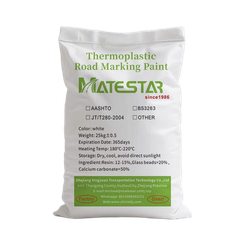

If one supplier offers thermoplastic road marking paint at a much lower price than other manufacturers but claims that:
- The resin content is the same;
- The glass bead content is the same;
- The whiteness and wear resistance are the same;
- The product meets the same standard;
You should ask one question:
If everything is the same, why is the price so much lower?
Thermoplastic road marking paint has clear raw material costs. Resin, titanium dioxide, glass beads, fillers, packaging, and production all affect the final price.
A supplier may reduce its profit margin or control costs through large-scale production. However, if the price is significantly below the normal market level while the supplier still promises the same formulation, standard, and performance, further verification is necessary.
Low-priced paint is not always the wrong choice. A more economical formulation may be suitable for temporary markings, low-traffic roads, factories, or parking areas. Highways, major urban roads, heavy-traffic roads, and projects with strict acceptance requirements need products that meet the relevant specifications.
Not every project requires the most expensive paint, but not every project is suitable for the lowest-priced product.
1. Why Do Thermoplastic Road Marking Paint Prices Vary So Much?
The price of thermoplastic road marking paint is mainly affected by:
- Resin type and content;
- Titanium dioxide and other pigment content;
- Filler type and proportion;
- Intermix glass bead content;
- Applicable product standard;
- Requirements for luminance, softening point, and wear resistance;
- Packaging specifications and actual net weight;
- Order quantity.
For this reason, thermoplastic road marking paint cannot have only one market price.
Some products are designed for temporary projects, factories, parking areas, or low-traffic roads, where controlling the purchase cost is the main priority. Other products are used on highways, major urban roads, or government projects and must meet stricter technical and acceptance requirements.
It is normal for these products to have different prices.
The real concern is not simply that a product is cheap. The concern is when a supplier offers a much lower price while claiming that the formulation, standard, and performance are identical to those of a higher-grade product, but cannot provide clear technical specifications or test data.
2. Where Does a Lower Price Usually Come From?
There are several legitimate ways to reduce the cost of thermoplastic road marking paint.
Adjusting the Resin System or Resin Content
Resin is an important component of thermoplastic road marking paint. It affects melt flow, adhesion, softening point, wear resistance, and stability at high temperatures.
Using a different resin system or adjusting the resin content will change the production cost.
This does not mean that a higher resin content always produces better paint. A suitable formulation must be designed according to the climate, pavement condition, application equipment, and project requirements.
Adjusting Titanium Dioxide and Pigment Content
Titanium dioxide and other pigments affect the luminance, hiding power, and color stability of white road markings.
An economy-grade product may reduce costs by adjusting its pigment system. However, its whiteness and long-term color performance may differ from those of a higher-grade product.
Increasing the Filler Proportion
Fillers are a normal part of thermoplastic road marking paint. The presence of fillers does not automatically mean that the product is poor quality.
However, one common way to reduce formulation costs is to increase the proportion of lower-cost fillers while reducing more expensive components such as resin, pigments, or glass beads.
The buyer should confirm whether the adjusted product can still meet the project requirements for softening point, flow properties, luminance, wear resistance, and application performance.
Reducing Intermix Glass Beads
Thermoplastic road marking paints may contain different levels of intermix glass beads.
Some products contain no intermix beads, while others contain 20% or 30%. These differences have a direct effect on the cost per tonne.
A quotation for paint without intermix glass beads cannot be compared directly with a quotation for paint containing 20% or 30% glass beads.
3. Does a Lower Price per Ton Really Reduce the Cost of a Full Container?

Assume that a buyer purchases one 26-ton container of thermoplastic road marking paint at USD 300 per ton.
The following examples show how differences in net weight, excess moisture, and material density may affect the actual cost.
These figures are only used to explain the calculation. Actual results should be based on weighing records, test results, and product data.
| Situation | Difference per Ton | Difference in a 26-Ton Container | Value at USD 300 per Ton |
|---|---|---|---|
| Nominal 1 ton, but actual net weight is 20 kg short | 20 kg | 520 kg | About USD 156 |
| Nominal 1 ton, but actual net weight is 30 kg short | 30 kg | 780 kg | About USD 234 |
| 5 kg of excess moisture per ton | 5 kg | 130 kg | About USD 39 |
| 10 kg of excess moisture per ton | 10 kg | 260 kg | About USD 78 |
These situations may not occur at the same time and should not be added together automatically. However, they demonstrate an important point:
A price that is USD 10 or USD 20 lower per tonne does not necessarily make the full container cheaper. The buyer must also consider how much usable material is actually received.
Different Density Means Different Coverage per Ton
The theoretical material consumption of thermoplastic road marking paint is directly related to application thickness and material density:
Theoretical consumption (kg/m²) = Application thickness (mm) × Material density (g/cm³)
Assume that both products are applied at a thickness of 2 mm:
| Item | Product A | Product B |
| Density | 2.2 g/cm³ | 2.3 g/cm³ |
| Theoretical consumption | 4.4 kg/m² | 4.6 kg/m² |
| Theoretical coverage per tonne | 227.3 m² | 217.4 m² |
| Material cost at USD 300 per tonne | USD 1.32/m² | USD 1.38/m² |
Product B theoretically covers approximately 9.9 m² less per tonne.
For a 26-ton container:
9.9 m² × 26 tons = 257.4 m²
The theoretical coverage difference between the two products is therefore approximately 257.4 m² per container.
If both products cost USD 300 per ton, Product B requires an additional 40 kg of material for every 200 m²:
(4.6 kg/m² − 4.4 kg/m²) × 200 m² = 40 kg
The additional material cost is:
0.04 tonne × USD 300 per tonne = USD 12
In theory, Product B, with a density of 2.3 g/cm³, must be approximately 4.35% cheaper per tonne than Product A, with a density of 2.2 g/cm³, for both products to have a similar material cost at a 2 mm application thickness.
If Product A costs USD 300 per ton:
USD 300 × 2.2 ÷ 2.3 = approximately USD 287 per ton
Product B would therefore need to cost approximately USD 287 per ton to offset the difference in theoretical coverage.
However, a higher density does not automatically mean lower quality. Density is also affected by the proportions of pigments, fillers, resin, and glass beads.
A more accurate conclusion is:
If the higher density comes from a larger proportion of low-cost fillers while resin, pigments, or glass beads are reduced, the lower price per tonne may simply reflect the use of fewer high-value raw materials.
Theoretical coverage is also different from actual job-site coverage. Pavement texture, application thickness, equipment control, material loss, and operator technique will all affect actual consumption.
4. Different Road Projects Can Use Different Grades of Paint
The most expensive thermoplastic road marking paint is not always the best purchasing choice.
The correct approach is to select a product grade that matches the actual project requirements.
| Project Type Main | n Purchasing Priorities Recommended | d Product Direction |
|---|---|---|
| Temporary markings and short-term projects | Low purchase cost and acceptable application performance | Economy formulation |
| Factories, parking areas, and low-traffic roads | Stable application, acceptable color, and basic wear resistance | Standard economy or regular grade |
| General municipal roads | Whiteness, adhesion, wear resistance, and application stability | Regular project grade |
| Major urban roads and higher-traffic roads | Wear resistance, deformation resistance, glass bead retention, and batch consistency. | Higher-performance formulation |
| Highways, heavy-traffic roads, and government projects | Compliance with project standards, testing, and acceptance requirements | Standard-compliant or customized formulation |
This table is only a general selection guide. The final product choice should always be based on the project specification, tender document, and local acceptance requirements.
There is no need to pay for unnecessary performance on an ordinary road project. However, a product that does not meet the required standard should not be selected simply to reduce the purchase price.
Conclusion: A Low Price Can Be Reasonable, but You Need to Know Why It Is Lower
There is nothing wrong with buyers paying close attention to price. For importers and distributors, purchase value, working capital, and resale price are important commercial considerations.
However, a low price can represent three very different situations.
The first is that the buyer intentionally selects a more economical product with a lower specification because it is suitable for the project.
The second is that the price per tonne appears lower, but insufficient net weight, excess moisture, or higher density reduces the amount of usable material or the coverage per tonne.
The third is that a supplier offers a significantly lower price while claiming that the formulation, standard, and performance are identical to those of a higher-grade product.
The first situation is a normal product choice. The other two require further verification through weighing records, technical documents, and test data.
There is no need to purchase the highest possible specification for every thermoplastic road marking project. However, buyers should be cautious about promises of "the lowest price, the highest specification, and the same performance."
A more practical purchasing principle is:
Choose thermoplastic road marking paint with a suitable price, transparent formulation, and performance that meets the actual road and project requirements.
If you are unsure which product grade your project requires, provide MATESTAR with the road type, applicable standard, estimated quantity, color, and destination port. We can recommend an economy-grade, regular-grade, or customized thermoplastic road marking paint and clearly explain the differences in formulation and price.


