
Quick Answer
In summer, thermoplastic road marking problems are mainly caused by high pavement temperature, slow cooling, low material viscosity during cooling, and improper glass bead embedment. When the marking stays too hot for too long, drop-on glass beads may sink too deep and reduce retroreflectivity. Contractors should monitor material and pavement temperature, avoid the hottest afternoon period, keep the surface dry, use a suitable summer formula, and choose proper glass beads.
Why Summer Application Needs Special Attention
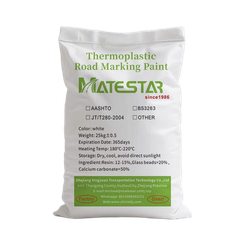
Thermoplastic road marking paint is normally applied at a high temperature. In many projects, the material is heated to around 180–220°C before application.
In summer, the air temperature is high. But the bigger issue is often the pavement temperature.
Asphalt pavement exposed to strong sunlight can become much hotter than the air. This changes the cooling speed of the thermoplastic marking after application.
In hot weather, the marking layer may stay soft for a longer time. This can affect:
- Glass bead embedment
- Retroreflectivity
- Surface finish
- Material consumption
- Cooling time before traffic opens
- Long-term marking durability
Summer application is not only about making sure the material is hot enough. It is about controlling the right temperature, the right viscosity, and the right cooling speed.
Key Problem: Drop-on Glass Beads May Sink Too Deep
One common summer problem is poor nighttime reflectivity.
In many cases, the reason is not that the glass beads are bad. The real reason is that the beads sink too deep into the hot thermoplastic layer.
Here is what happens:
- The pavement is very hot.
- The thermoplastic marking cools down slowly.
- The material stays in a low-viscosity state for longer.
- Drop-on glass beads cannot stay at the right depth.
- The beads sink too deep.
- Light from vehicle headlights cannot enter and return properly.
- Retroreflectivity becomes lower.
Good reflectivity depends on correct glass bead embedment.
If the beads are too shallow, they may fall off easily.
If the beads are too deep, light cannot return well.
If the beads are embedded properly, the marking can keep better nighttime visibility.
In many thermoplastic road marking projects, a good bead embedment depth is about 50–60% of the bead diameter. This allows light to enter the bead, reflect from the marking layer, and return toward the driver.
Material Temperature Control in Hot Weather
Thermoplastic paint needs heat to melt and flow. But higher temperature is not always better.
If the material temperature is too low:
- Flow leveling may be poor.
- The surface may become rough.
- Glass beads may not embed properly.
- Adhesion may become weak.
- But if the material temperature is too high:
- Glass beads may sink too deep.
- Material consumption may increase.
- Resin may age faster.
- White markings may turn yellow.
- The marking may become brittle after repeated heating.
- The surface may become too soft before cooling.

In summer, the kettle temperature can rise quickly. Contractors should avoid long-time overheating, especially when the material is waiting in the kettle before application.
A practical rule is:
Do not only heat the material. Control the material.
The material should be heated within the recommended working range, stirred evenly, and applied before the resin system is damaged by long-time high temperature.
Pavement Temperature Matters
Many contractors only check the thermoplastic kettle temperature. But in summer, pavement temperature is also very important.
The same material may perform differently on:
- Shaded pavement
- Pavement under direct sunlight
- New asphalt
- Old asphalt
- Concrete pavement
- Rough asphalt surface
- Smooth asphalt surface
On very hot asphalt, thermoplastic material cools more slowly. This gives glass beads more time to sink. It may also delay the time before traffic can open.
That is why contractors should use an infrared thermometer to check the pavement temperature, especially in hot climates.
Do not judge only by air temperature.
A road surface under strong sunlight may be much hotter than the air around it.
Primer, Moisture and Surface Preparation
Summer is hot, but many summer projects also happen during rainy or humid seasons.
This creates another problem: moisture.
Thermoplastic paint should not be applied on wet pavement. If moisture is trapped in the pavement, the heat from the molten material can turn it into vapor. This may cause bubbles, pinholes, or poor bonding.
Primer can also cause problems if it is not fully dry.
If primer solvent has not evaporated completely, the heat from thermoplastic paint may make it vaporize quickly. This can create bubbles under the marking layer and weaken adhesion.
Before application, contractors should check:
- Is the pavement fully dry?
- Is there morning dew?
- Has the road been rained on recently?
- Is the primer fully dry?
- Is the surface clean and free from dust or oil?
- Are the thermoplastic material and glass beads stored in dry conditions?
Hot weather does not mean moisture risk disappears. In some regions, high humidity can make primer drying and surface preparation more difficult.
Practical Summer Application Tips
1. Avoid the Hottest Afternoon Period
If possible, avoid application during the hottest part of the day.
The best time is often early morning or late afternoon, depending on local weather and pavement temperature.
When the pavement is too hot, the marking may cool too slowly. This can increase the risk of bead sinking, poor reflectivity, and longer traffic opening time.
2. Use an Infrared Thermometer
Do not rely only on the kettle temperature gauge.
Use an infrared thermometer to check:
- Pavement temperature
- Material temperature near application
- Surface temperature before traffic opens
This is especially useful in hot climates, highway projects, and large open asphalt roads exposed to sunlight.
3. Control Material Temperature Carefully
Thermoplastic paint should be heated evenly and stirred properly.
Avoid:
- Long-time heating
- Repeated heating
- Strong fire without control
- Leaving material in the kettle too long
- Applying overheated material
- Mixing fresh material with badly aged leftover material
If the material has been overheated for too long, the resin may age. This can affect color, flow, toughness, and long-term durability.
4. Choose Suitable Glass Beads
Glass bead selection is very important in summer.
If the pavement temperature is high and the thermoplastic layer stays soft longer, smaller or uncoated beads may sink more easily.
For some hot-weather projects, contractors may consider:
- Larger drop-on glass beads
- Coated glass beads
- Glass beads with good roundness
- Beads matched with marking thickness
- Stable bead spreading rate
Larger beads sink more slowly. Coated beads may help improve bead behavior and bonding with the marking layer.
But bead choice should still match the project standard, marking thickness, application method, and retroreflectivity requirement.
5. Use a Summer-Adjusted Formula
In hot weather, the thermoplastic formula may need better bead-holding ability.
A suitable summer formula should help the material keep enough viscosity during cooling, so the glass beads do not sink too deep.
This may involve:
- Proper resin content
- Balanced plasticizer level
- Higher viscosity at working temperature
- Good flow without excessive softness
- Stable softening point
- Better resistance to high pavement temperature
A good summer formula is not simply "harder material." It should balance flow leveling, bead embedment, wear resistance, and heat stability.
If the material is too soft, beads may sink and the line may deform.
If the material is too hard, flow leveling and adhesion may become worse.
Formula balance is the key.
6. Check Primer Drying Before Application
Primer must be dry before thermoplastic marking is applied.
In summer, primer may dry faster under strong sun, but high humidity can still slow down drying. Thick primer layers may also remain wet under the surface.
Do not apply hot thermoplastic paint over wet or sticky primer.
Undried primer may lead to:
- Bubbles
- Poor adhesion
- Peeling
- Surface defects
- Safety risks from solvent vapor
The right drying time depends on primer type, coating thickness, humidity, wind, and pavement temperature.
7. Run a Short Trial Line
Before large-scale application, a short trial line is useful.
A trial line can help check:
- Flow leveling
- Surface finish
- Glass bead embedment
- Reflectivity
- Bubble risk
- Cooling speed
- Traffic opening time
This is especially important when the project is in a hot climate, on new asphalt, or when using a new formula or new glass bead type.
A short test can prevent large-area quality problems.
8. Allow Enough Cooling Time Before Traffic Opens
Thermoplastic markings dry quickly, but they still need enough time to cool and become stable.
In summer, the marking may stay soft for longer. If traffic opens too early, especially heavy vehicles, the line may show:
- Tire marks
- Surface deformation
- Glass bead loss
- Early wear
- Cracks or surface damage
Before opening traffic, check whether the marking surface has cooled enough.
Do not open heavy traffic only because the surface "looks dry."
Summer Application Diagnosis Table
|
Problem |
Likely Cause |
How to Check |
Solution Direction |
|
Glass beads sink too deep |
Pavement too hot, cooling too slow |
Check bead embedment and night reflectivity |
Avoid hottest period, adjust formula, use larger or coated beads |
|
Poor retroreflectivity |
Beads too deep, too shallow, or uneven |
Use retroreflectometer and inspect bead position |
Adjust bead size, bead spreading, material viscosity, and application temperature |
|
Yellowing of white marking |
Overheating or long heating time |
Check kettle temperature and heating duration |
Control temperature, avoid repeated heating |
|
Bubbles or pinholes |
Moisture, undried primer, or trapped air |
Check pavement dryness and primer condition |
Dry pavement, wait for primer to dry fully |
|
Tire marks after application |
Traffic opened too early |
Check surface temperature and opening time |
Allow marking to cool before traffic opens |
|
Poor flow leveling |
Temperature too low or formula not suitable |
Check material flow and surface finish |
Adjust material temperature and formula |
|
Fast bead loss |
Beads too shallow or poor bonding |
Check bead embedment and traffic wear |
Improve bead timing, bead type, and surface condition |
Is Higher Temperature Always Better for Flow?
No.
Higher temperature can improve flow, but it can also create new problems.
When thermoplastic material becomes too hot, viscosity becomes lower. In summer, if the pavement is also very hot, the marking may stay soft for too long.
This can cause:
- Glass beads sinking too deep
- More material consumption
- Longer cooling time
- Yellowing
- Resin aging
- Surface deformation
- Early traffic damage
So the goal is not to make the material as hot as possible.
The goal is to keep the material at the right working temperature and the right viscosity for the road condition.
In summer application, temperature control is not only about flow. It is also about bead embedment, reflectivity, and long-term durability.
FAQ
Why do glass beads sink in summer thermoplastic markings?
Glass beads may sink because the pavement is very hot and the thermoplastic marking cools slowly. The material stays soft for longer, and its viscosity may not be high enough to hold the drop-on beads at the right depth.
Should thermoplastic paint be applied hotter in summer?
Not always. Higher temperature may improve flow, but it can also reduce viscosity, make beads sink too deep, increase material consumption, and accelerate resin aging. The right temperature depends on the formula, pavement temperature, and application method.
What is the right application temperature for thermoplastic road marking?
Thermoplastic road marking paint is commonly applied around 180–220°C, but the exact working range should follow the supplier's recommendation and project conditions. In summer, contractors should also check pavement temperature and cooling speed.
How can contractors improve reflectivity in hot weather?
Contractors can improve reflectivity by controlling material and pavement temperature, choosing suitable drop-on glass beads, keeping bead embedment at the right depth, checking bead spreading, and running a short trial line before full application.
Can humidity affect thermoplastic road marking in summer?
Yes. High humidity, wet pavement, undried primer, or moisture in stored material can affect bonding and surface quality. Moisture may also cause bubbles or pinholes when hot thermoplastic material is applied.
Are coated glass beads useful in summer?
Coated glass beads can help improve bead behavior and bonding in some projects. They may be useful when bead sinking, bead loss, or reflectivity stability is a concern. The final choice should depend on project standard, marking thickness, and application temperature.
For Contractors and Importers
Summer thermoplastic road marking quality depends on temperature control, pavement condition, material formula, glass bead selection, and traffic opening time.
For hot-weather projects, the formula should not only flow well. It should also keep enough viscosity during cooling, hold glass beads properly, resist high pavement temperature, and maintain good retroreflectivity.
If you are preparing a road marking project in a hot climate, please send us:
- Project country
- Pavement type
- Summer temperature range
- Required quantity
- White or yellow color
- Required standard
- Glass bead requirement
- Destination port
Our team can recommend a suitable thermoplastic road marking paint formula and glass bead system based on your project conditions.