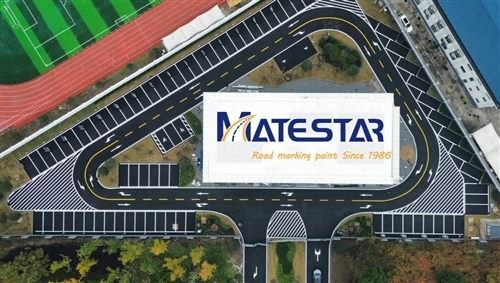
Road marking materials differ in application method, drying mechanism, thickness, equipment requirements and long-term performance.
According to material-based classifications commonly used in road engineering, the five main types are:
- Solvent-based road marking paint
- Thermoplastic road marking paint
- Water-based road marking paint
- Two-component road marking material
- Preformed road markings
Although the term "road marking paint" is widely used, preformed tapes and symbols are not technically paints. They are included because contractors and road authorities commonly compare them with liquid and thermoplastic materials during project selection.
1. Solvent-Based Road Marking Paint
Solvent-based road marking paint is a single-component liquid coating. After application, the solvent evaporates and leaves a solid marking film on the pavement.
It can normally be applied by airless spraying, conventional spraying or rolling without heating.
Advantages
- Simple application process
- No thermoplastic preheater required
- Suitable for mechanical spraying
- Relatively low initial equipment investment
- Less sensitive to humidity than many water-based products
Limitations
- Produces VOC emissions during application
- Forms a relatively thin marking layer
- May require more frequent maintenance under heavy traffic
- Road surfaces must still be clean and sufficiently dry
Common applications
Solvent-based paint is commonly used for parking areas, factory roads, low-traffic roads, maintenance markings and temporary traffic control.
2. Thermoplastic Road Marking Paint
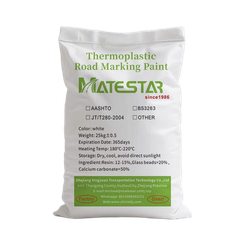
Thermoplastic road marking paint is supplied as a solid powder. It normally contains synthetic resin, pigments, fillers, additives and glass beads.
The material is heated until molten, applied to the pavement and then solidifies as it cools. It can be applied by screed, extrusion or spray methods.
Advantages
- Fast solidification after application
- Thick and wear-resistant marking layer
- Suitable for premixed and drop-on glass beads
- Good productivity on large road projects
- Can be formulated for different climates and application methods
Limitations
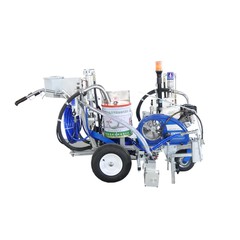
- Requires a thermoplastic preheater and marking machine
- Material temperature must be controlled during melting and application
- Extended or repeated heating may cause discoloration and resin degradation
- Concrete, polished or contaminated surfaces require proper preparation and compatible primer
Common applications
Thermoplastic road marking paint is widely used on highways, national roads, urban arterial roads, intersections, pedestrian crossings and other roads requiring durable markings.
It is especially practical when contractors already have thermoplastic melting and application equipment.
3. Water-Based Road Marking Paint
Water-based road marking paint uses water as its main carrier. The marking forms as water evaporates and the binder develops a continuous film.
Most water-based traffic paints are applied by spraying.
Advantages
- Lower VOC emissions than conventional solvent-based paint
- Easier equipment cleaning
- No heating process required
- Suitable for high-speed mechanical spraying
- Useful for projects with environmental restrictions
Limitations
- Drying is affected by temperature, humidity and airflow
- Application during cold or humid conditions requires additional control
- Usually forms a thinner coating than screed-applied thermoplastic
- Surface cleanliness strongly affects adhesion
Common applications
Water-based road marking paint can be used on urban roads, parking areas, airports, industrial facilities and other projects requiring spray application and lower VOC emissions.
It should not automatically be classified as a temporary material. Its performance depends on the binder system, film thickness, road condition, traffic and application quality.
4. Two-Component Road Marking Material
Two-component road marking materials cure through a chemical reaction between two components.
This category includes several resin technologies, such as:
- Methyl methacrylate, or MMA
- Epoxy
- Polyurea
- Other reactive resin systems
Therefore, MMA and epoxy should not be treated as completely separate basic categories when explaining road marking materials.
Advantages
- Strong adhesion when correctly applied
- Good abrasion and chemical resistance
- Suitable for flat, structured and profiled markings
- Can provide thicker applications
- Useful for specialized, high-performance projects
Limitations
- Mixing ratios must be controlled accurately
- Application equipment is more complex
- Pot life and curing conditions must be considered
- Material and installation costs are generally higher than conventional traffic paint
Common applications
Two-component materials are used on intersections, crosswalks, bus lanes, bicycle lanes, airports, high-wear zones and projects requiring structured or high-performance markings.
5. Preformed Road Markings
Preformed road markings are manufactured before they arrive at the construction site.
They mainly include:
- Preformed thermoplastic markings
- Polymer road marking tape
- Pre-cut arrows, letters and symbols
- Temporary removable marking tape
Preformed thermoplastic is installed by heating it until it bonds with the pavement. Some polymer tapes are installed with pressure-sensitive or separate adhesives.
Advantages
- Consistent shape and thickness
- Convenient for arrows, symbols and lettering
- Faster installation for small or complex markings
- Factory-controlled design and bead distribution
- Temporary tapes can be removed when no longer required
Limitations
- Higher material cost per marked area
- Surface preparation is critical
- Not always economical for long continuous lines
- Adhesion depends on the pavement texture and installation method
Common applications
Preformed markings are mainly used for arrows, numbers, warning symbols, pedestrian facilities, repair sections and temporary traffic management.
Comparison of the Five Road Marking Materials
| Material | How it hardens | Typical equipment | Main strength | Main limitation |
|---|---|---|---|---|
| Solvent-based paint | Solvent evaporation | Cold paint sprayer | Simple application | VOC emissions and thinner film |
| Thermoplastic paint | Cooling after heating | Preheater and thermoplastic machine | Thick, durable marking | Requires heating equipment |
| Water-based paint | Water evaporation and film formation | Cold paint sprayer | Lower VOC emissions | Weather-sensitive drying |
| Two-component material | Chemical reaction | Dedicated mixing and application equipment | Specialized performance | Higher application complexity |
| Preformed marking | Heat bonding or adhesive | Torch or tape applicator | Consistent symbols and shapes | Higher cost for large areas |
How to Choose the Right Road Marking Material
Consider the traffic level
High-traffic roads generally require a material with sufficient thickness, wear resistance and glass bead retention.
Thermoplastic and two-component materials are commonly considered for these conditions. Liquid paint may be more suitable for low-traffic roads or locations where regular repainting is acceptable.
Check the pavement surface
Asphalt, new concrete, old concrete and previously marked roads have different surface characteristics.
Concrete and smooth surfaces may require grinding, shot blasting or primer. Selecting a durable material cannot compensate for poor surface preparation.
Evaluate the climate
Temperature and humidity affect application and final performance.
Water-based paint needs suitable drying conditions. Thermoplastic formulas should match local pavement temperatures and seasonal conditions. Two-component systems must be applied within their specified curing range.
Confirm the available equipment
The selected material must match the contractor's application equipment.
A thermoplastic project requires melting and laying equipment. Two-component systems require accurate mixing equipment. Water-based and solvent-based paints usually use airless spraying equipment.
Compare total marking cost
Purchase price alone does not represent the real project cost.
The calculation should also include:
- Material consumption per square metre
- Application equipment
- Labour and traffic control
- Surface preparation
- Expected maintenance frequency
- Removal and remarking costs
A cheaper material may cost more if it requires frequent repainting or produces inconsistent coverage.
Which Road Marking Material Is Best?
There is no single best material for every road.
Choose thermoplastic when the project requires a durable, thick marking and the contractor has suitable heating equipment. Choose liquid paint when easy spraying and fast project deployment are more important. Consider two-component or preformed systems when the project requires specialized performance, structured markings or factory-made symbols.
The final choice should always follow the local project specification and applicable road marking standards.
Frequently Asked Questions
What is the most commonly used road marking material?
It depends on the country and road authority. Thermoplastic is widely used on highways and urban roads in many Asian, African and Middle Eastern markets. Water-based paint, thermoplastic and preformed tape are also widely used by different US road authorities.
Is reflective road marking paint a separate material type?
No. Reflectivity is a performance characteristic, not a basic material category. Thermoplastic, water-based, solvent-based and two-component markings can all become reflective by using suitable glass beads or other reflective elements.
Are MMA and epoxy separate road marking categories?
They are different resin technologies, but both belong to the broader two-component or reactive road marking material category.
Can thermoplastic road marking paint be applied on concrete?
Yes, but the concrete must be properly prepared. Surface contaminants and curing compounds should be removed, and a compatible primer is normally required.
Which road marking paint is suitable for highways?
Thermoplastic and two-component materials are commonly used for highway projects, but the final decision depends on traffic, climate, pavement condition, required retroreflectivity and the project specification.
What information should be provided when requesting a quotation?
Provide the destination country, road type, pavement surface, application method, required standard, marking thickness, colour and estimated quantity.
Conclusion
The five common pavement marking material types differ not only in price, but also in curing mechanism, film thickness, equipment requirements and suitable applications.
A reliable selection should begin with the project specification, road surface, climate and traffic conditions. Only after these factors are confirmed should contractors compare product specifications and cost per marked area.
MATESTAR supplies thermoplastic and water-based road marking paint, reflective glass beads and road marking equipment for international road projects. Contact us with your project conditions and required quantity for a suitable product recommendation.