

Fluid

Durable

Economical

Retroreflective

Anti-slip
Thermoplastic Pavement Antiskid Paint
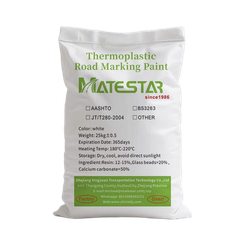
Thermoplastic pavement antiskid paint is a heat-applied material designed to improve pavement skid resistance. It is formulated with thermoplastic resin, pigments, fillers, antiskid aggregate, and other additives. The material is heated to (200 ± 20)°C for application and then physically cools and hardens at ambient temperature, forming an antiskid coating with a rough surface and three-dimensional texture.
Compared with conventional flat thermoplastic road markings, thermoplastic pavement antiskid paint does more than rely on internally mixed antiskid aggregate to increase surface friction. It can also be applied with specialized equipment to form serrated or other raised textures. The hard aggregate increases the microscopic roughness of the coating, while the raised texture breaks up continuous water films and provides drainage paths, improving vehicle stability in wet conditions, on curves, on slopes, and in braking areas.
How the Antiskid System Works
Thermoplastic pavement antiskid paint improves friction between the tire and the coating through two complementary structures.

High-hardness antiskid aggregate with distinct angular edges is uniformly mixed into the material. After application, part of the aggregate remains exposed at the coating surface, turning an otherwise relatively smooth marking into a hard and rough microscopic contact surface.
When vehicles pass over the coating, the tires come into direct contact with these exposed hard particles. Their angular shape and rough surface increase friction between the tire and the coating, reducing the risk of slipping on smooth conventional markings under wet conditions.
In simple terms:
The hard aggregate solves the problem of an overly smooth coating surface.
Serrated Texture Breaks Up Water Films and Provides Structural Skid Resistance
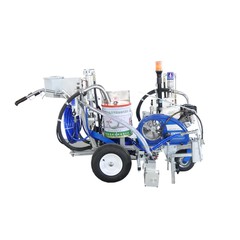
During application, the molten material is laid with a specialized antiskid screed box, creating a continuous serrated and raised texture instead of the flat surface formed by conventional thermoplastic markings.
The raised sections and grooves divide the continuous water film on the coating surface and provide space for water to drain away. As a vehicle passes over the marking, the tire contacts multiple raised points rather than a single smooth surface, improving grip under wet conditions.
The three-dimensional texture also helps distribute wheel loads and slows the overall flattening of the coating surface.
In simple terms:The serrated texture breaks up continuous water films, provides drainage space, and improves wet-weather grip through a raised structural profile.
Dual Antiskid Action
The hard aggregate increases microscopic surface roughness, while the serrated texture provides macroscopic drainage and structural skid resistance.
Together, these two mechanisms improve skid resistance in wet conditions, on curves, on slopes, in braking zones, and in areas used by heavy vehicles.
Product Features
High Skid Resistance
Hard, angular aggregate forms a rough contact surface, while the serrated texture breaks up water films and provides drainage paths.
Antiskid performance is classified as follows:
√Ordinary antiskid type: 45 ≤ BPN < 55
√Medium antiskid type: 55 ≤ BPN < 70
√High antiskid type: BPN ≥ 70
High Wear Resistance
The antiskid aggregate has high hardness, angularity, and abrasion resistance, allowing the coating to retain effective surface roughness and skid resistance after prolonged traffic wear.
After the coating wear test, the following requirements apply:
√Ordinary antiskid type: BPN ≥ 45
√Medium antiskid type: BPN ≥ 50
√High antiskid type: BPN ≥ 55
√Wear rate: ≤1.0%
High Compressive Strength
The thermoplastic resin binds the antiskid aggregate, pigments, and fillers into a stable structure that can withstand repeated vehicle loading.
Required compressive strength:
√At (23 ± 1)°C: ≥12.0 MPa
√At (60 ± 2)°C: ≥2.0 MPa
High-Temperature Resistance
The material maintains good structural stability on hot pavement and during prolonged heating.
Typical requirements include:
√Heat deformation resistance: ≥70%
√After continuous heating at (200 ± 10)°C for 4 hours, there should be no obvious discoloration, charring, or agglomeration.
Stable Adhesion
The resin binder securely bonds the antiskid aggregate to the pavement, reducing the risk of peeling, delamination, and aggregate loss.
Pull-off adhesion strength should be ≥1.5 MPa. The coating should also meet the relevant requirements for water resistance, alkali resistance, and low-temperature cracking resistance.
Fast Reopening to Traffic
The thermoplastic material hardens by physical cooling after application and does not require a long chemical curing period.
The no-pick-up drying time should be ≤10 minutes. Actual reopening time depends on ambient temperature, application thickness, pavement temperature, and site cooling conditions.
Product Composition
Thermoplastic Resin
Thermoplastic resin is the primary binding component. It holds the antiskid aggregate, pigments, fillers, and other additives together to form a complete coating structure.
The resin system can be adjusted according to climate and road conditions to improve:
√High-temperature stability
√Low-temperature cracking resistance
√Adhesion to asphalt or concrete pavement
√Melt flow characteristics
√Texture-forming performance during application
Antiskid Aggregate
Thermoplastic pavement antiskid paint is a powdered material containing internally mixed antiskid aggregate.
The antiskid aggregate is the key component responsible for surface roughness and skid resistance. It should meet the following requirements:
| Test Item | Technical Requirement |
| Mohs hardness | ≥6 |
| Passing rate through 4.75 mm sieve | 95%–100% |
| Retained rate on 2.36 mm sieve | 80%–100% |
| Clay content | ≤2.0% |
| Water absorption | ≤2.0% |
| Abrasion loss | ≤28.0% |
| Soundness loss | ≤8.0% |
| Angularity, flow time | ≥30 s |
| Moisture content | ≤2.0% |
Stable aggregate hardness and angularity help maintain surface friction. Low water absorption and low moisture content also help reduce vapor release, blistering, and weak bonding between the aggregate and resin during high-temperature application.
Pigments and Fillers
Pigments are used to produce white, yellow, red, green, blue, and other project-specific colors.
Fillers are used to adjust material flow, hardness, density, and texture-forming performance.
Glass Beads
Reflective pavement antiskid paint may be used with glass beads.
The glass beads work together with the antiskid aggregate to improve nighttime visibility under vehicle headlights while maintaining skid resistance.
Main Technical Requirements
Antiskid Classification
| Antiskid Grade | Initial BPN Value |
| Ordinary antiskid type | 45 ≤ BPN < 55 |
| Medium antiskid type | 55 ≤ BPN < 70 |
| High antiskid type | BPN ≥ 70 |
Specific Requirements for Thermoplastic Products
| Test Item | Technical Requirement |
| Condition in the container | Dry, free from lumps and foreign matter, and uniformly loose after mixing |
| No-pick-up drying time | ≤10 min |
| Compressive strength at 23°C | ≥12.0 MPa |
| Compressive strength at 60°C | ≥2.0 MPa |
| Heat deformation resistance | ≥70% |
| Heating stability | No obvious discoloration, charring, or agglomeration after heating at 200 ± 10°C for 4 h |
| VOC and heavy metals | Comply with JT/T 1326-2020 |
Main Applications
Expressways
Suitable for:
- Straight-ahead, turning, and merging arrows
- Longitudinal deceleration markings
- Transverse deceleration markings
- Expressway ramps
- Interchanges
- Toll station areas
- Sharp curves and long downhill sections
National and Provincial Highways
Suitable for:
- Accident-prone sections
- Heavy-vehicle routes
- Long downhill braking zones
- Sharp curves and areas with restricted visibility
- Intersections and pedestrian crossings
Urban Roads
Suitable for:
- School and hospital zones
- Bus stops and bus lanes
- Tunnel entrances and exits
- Urban intersections
- Antiskid pedestrian crossings
- Downhill and water-prone sections
Special Areas
Suitable for:
- Parking ramps
- Underground garage entrances and exits
- Port roads
- Heavy-duty factory roads
- Toll station pavements
- Areas with frequent braking or turning movements
Application Procedure
Pavement Preparation
Remove dust, sand, oil, loose particles, and standing water from the pavement. The surface must be clean and dry before application.
Moisture, dust, and oil can directly reduce adhesion and may cause blistering, pinholes, and later delamination.
Setting Out
Mark the position, direction, and dimensions of arrows, deceleration markings, pedestrian crossings, or other patterns according to the construction drawings.
Large arrows and complex patterns may be set out in sections and formed with partial templates.
Primer Application
Select a suitable primer according to whether the pavement is asphalt or cement concrete.
The primer must be fully dry before thermoplastic application. Residual solvent or moisture may vaporize under heat, causing blistering and poor adhesion.
Material Heating
Place the material in a thermoplastic preheater and heat it to (200 ± 20)°C while continuously stirring to keep the resin, pigments, fillers, and aggregate uniformly distributed.
Do not hold the material at excessive temperature for a prolonged period, as this may cause discoloration, charring, and agglomeration.
Antiskid Texture Formation
Apply the material evenly with a specialized antiskid screed box and form a continuous serrated, raised texture.
The following parameters should remain stable during application:
- Material temperature
- Screed box speed
- Material output
- Application thickness
- Texture height
- Texture continuity
Glass Bead Application
For reflective products, glass beads should be evenly applied while the coating is still molten.
If applied too early, the beads may sink too deeply. If applied too late, they may not bond securely.
Cooling and Reopening to Traffic
Allow the material to cool naturally until it reaches a no-pick-up condition.
The standard no-pick-up drying time is no more than 10 minutes. Actual reopening time depends on application thickness, ambient temperature, and pavement temperature.
Key Application Controls
Excessive Material Temperature
If the material temperature is too high, the melt becomes overly fluid and the newly formed serrated texture may level out, causing the three-dimensional antiskid structure to disappear.
Prolonged overheating may also cause resin degradation, discoloration, charring, and agglomeration.
Insufficient Material Temperature
If the material temperature is too low, melt viscosity increases and flow becomes poor. The material may also cool too quickly to properly wet the pavement.
This may cause:
- Incomplete texture formation
- Irregular edges
- Reduced adhesion
- Localized voids or debonding
- Large-area peeling at a later stage
The Pavement Must Be Dry
Moisture and trapped air in the pavement expand or vaporize when exposed to the hot material, causing blisters, pinholes, and voids.
The pavement and primer must therefore be fully dry before application.
Overcoating Existing Coatings
Existing coatings may only be overcoated when they are sound and free from obvious peeling, hollow areas, or loose sections.
Existing coatings with significant height differences, cracking, or delamination should be ground or removed before application.
Low-Temperature Application
Under low-temperature conditions, the material cools rapidly, increasing the risk of poor adhesion and low-temperature cracking.
The formulation, application temperature, screed box speed, and primer drying time should be adjusted according to pavement temperature.